A June Morning
9.7.2025 (Written in 2019)
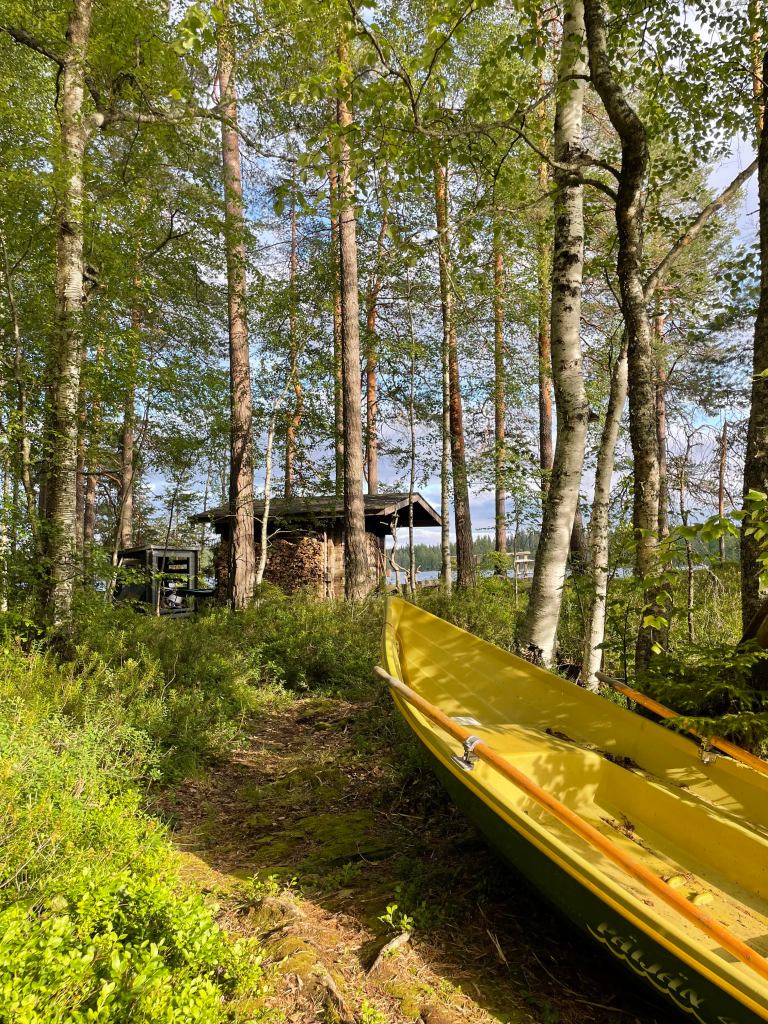
This blog series starts with a piece I wrote at nineteen, during a summer I spent living alone in the forest by a lake.
It’s amusing to revisit these writings—especially the so-called life wisdoms I believed I had grasped back then. Some things I’ve come to understand more clearly since, and many lessons are still ahead of me. Have a read!
“The tranquility of the lake spreads to the other creatures nearby, calming a restless soul. The lake is home to many living things, just as the mind is home to many thoughts. Its islands represent life’s most important insights, the ones worth keeping afloat. Streams flow into the lake, constantly bringing new and interesting thoughts from distant places—and streams also flow out, carrying away the unnecessary and spent ones. In this way, the balance of the mind is maintained.”
A June morning greets the one who wakes with a friendly intent, offering sunbeams directly onto the porch. One can only begin to appreciate the light once the eyes have been rubbed free from the crust that has gathered overnight. It’s a joy to realize that the sun has once again made the effort to drag itself into the sky, just as it has done for the past four and a half billion years. On mornings like this, it’s easy for a thinker to forget the purpose of the day. The allure of a reclining position in a sun chair, or of whistling idly by the lake, resembles the gravitational pull of a singularity hidden deep within a black hole. But now, resistance is needed, for someone has said that studying for the last exams is worthwhile.
Steam rises from a cup of coffee, from which a small piece has chipped off. The damage can be explained by the lack of coordination in an adult human’s hand. Already at five months of age, humans learn to grasp objects. At nineteen, the peak of dexterity is clearly behind, and the descent into the golden age of clumsiness has begun. Still, the thinker manages to squeeze one thought out of this: the small cracks in life should not affect the quality of existence—just as the chip in the coffee cup does not affect the taste of the coffee. So muses the thinker of Katiskalahti on this beautiful morning.
Nature is alive today and does not leave its observer unmoved. The warmth brought by spring unleashes scents, sounds, and colors—until winter’s cold presence eventually calms them again. The thinker notices a pair of gulls on a nearby island engaged in a heated discussion. As usual, she wonders what the quarrel might be about. Is the female upset because the male spends his evenings carousing with his buddies on the opposite shore and shirks his responsibilities in incubating the eggs? Or is the male annoyed at the female’s slowness when preparing to leave for a fishing trip? Why must she spend so much time preening her feathers, even if they might run into some superficial acquaintances? On this matter, the thinker decides not to get involved—it’s hard to play relationship therapist without a shared language. And really, what business is it of hers anyway?
The thinker of Katiskalahti is a simple person. She smiles at the beautiful coloring of a robin and curses when she stubs her toe on a chair leg. Either nothing moves in her head, or everything does. The traffic of thoughts in her mind occasionally becomes congested, and then the thinker needs to row out onto the lake. The calm water, mirroring the sky, reflects her ideal state of mind. The tranquility of the lake spreads to the other creatures nearby, calming a restless soul. The lake is home to many living things, just as the mind is home to many thoughts. Its islands represent life’s most important insights, the ones worth keeping afloat. Streams flow into the lake, constantly bringing new and interesting thoughts from distant places—and streams also flow out, carrying away the unnecessary and spent ones. In this way, the balance of the mind is maintained.
Sometimes, the thinker takes a fishing rod with her to the lake. And she doesn’t mind much if a wriggling pike doesn’t rise from the depths. As a child, the greatest joy of a fishing trip was the overwhelming pride of showing off the big catch. But with age, that pride has shifted into a different feeling—the little leap of the heart when there’s a tug on the line. She is content with her life, regardless. Most of all, on the lake.
– Helena, 2019.
 Quiet Paths
Leave a comment